
We asked, Yamaha answered
Story: Anvay Mahajan
Photography: Siddharth Dadhe
Every time we shared a Yamaha-related post on our social media, the comments followed a familiar pattern. Enthusiasts repeatedly asked when global favourites such as the Ténéré 700, R7 or the much-talked-about R9 would arrive in India. Yet, among all those requests, one motorcycle stood out. It wasn’t a big-capacity machine, nor an unattainable dream bike, but it sparked the loudest demand, attracting hundreds of comments across our platforms. Indian riders were unmistakably clear about what they wanted. And now, Yamaha India has finally answered the call of the ‘Men in Blue’, bringing the much-awaited Yamaha XSR 155 to our country. Late, but better than never. And we had it at our disposal for a week to ride around the town.
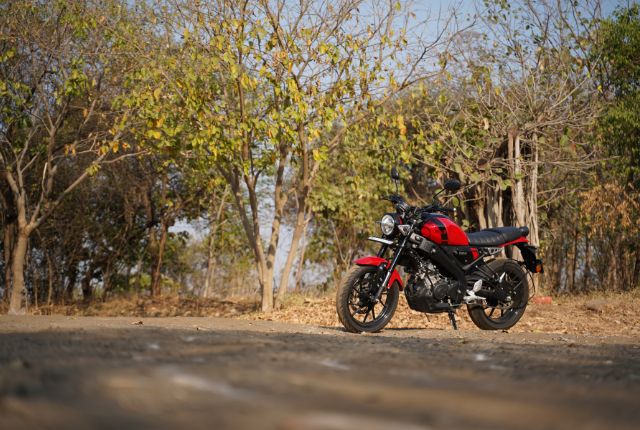
The XSR 155’s design is clearly inspired by its larger sibling, the XSR 900, following a retro-modern design philosophy. At first glance, the motorcycle looks attractive and has undeniable visual appeal. However, a closer inspection reveals that the proportions aren’t entirely convincing. Elements such as the relatively small 10-litre fuel tank, the exposed Deltabox frame and engine, along with the round headlamp and tail-lamp, don’t quite come together cohesively for me. In fact, we came across a few people who at first glance were excited to see this bike but, on a closer look, started to realise the design of the bike is slightly off. But in the end, design is subjective, and this bike does turn heads.
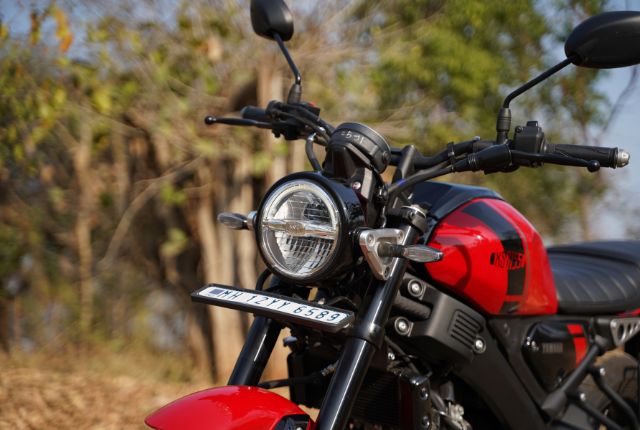
There are also a few areas where the build quality feels less premium than expected. For instance, the noticeable gap between the fuel tank and the ignition switch panel stood out, and I found myself being careful not to drop the keys into that space. The front HSRP registration plate mount is sturdy but does not look aesthetic. That said, Yamaha does offer official customization kits at an additional cost, allowing the XSR 155 to be styled either as a café racer or a scrambler. Of the two, the café racer kit significantly improves the bike’s overall visual balance.

On the features front, the XSR 155 gets a round LCD digital instrument console that displays all the essential information and offers smartphone connectivity via Yamaha’s Y-Connect application. Through the app, riders can receive calls, messages, and email alerts directly on the screen. While the system is functional, a brighter display or a colour TFT would have elevated the experience and matched modern expectations. Another point worth noting is the switchgear layout. Yamaha has swapped the conventional positions of the horn and indicator switches on the left stalk, and the ignition button and hazard lights on the right. This layout feels unintuitive and can become an ergonomic hindrance, particularly in stop-and-go traffic where quick and instinctive inputs are crucial.
Powering the XSR 155 is the same engine last seen on the YZF-R15, MT-15, and Aerox 155. This 155-cc, liquid-cooled, SOHC, four-valve, single-cylinder motor produces 18.4 hp and 14.2 Nm. Performance is great at the low end, with a healthy mid-range that makes the bike easy and engaging to ride. However, once past around 7,500 rpm, vibrations begin to creep in. The six-speed gearbox does its job but isn’t the slickest. Shifts feel slightly hard, particularly between first, second, and third. That said, the engine’s tractability is impressive. The XSR 155 can comfortably pull from very low speeds even in higher gears. On one occasion, I came to a halt at a gentle uphill intersection in second gear without realising it, and the bike pulled away smoothly without hesitation. The kerb weight of the XSR 155 is just 137 kilograms. So, the power-to-weight ratio is about 134.30 hp per tonne. This gives the motorcycle a massive advantage over its competitors. Apart from that, the instrument console also features a litre/100 km fuel efficiency meter. We got a decent 2.5 litre/100 km fuel efficiency which translates to 40 km/l.
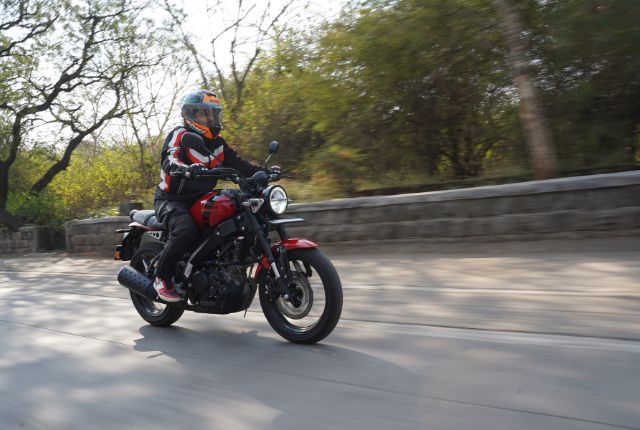
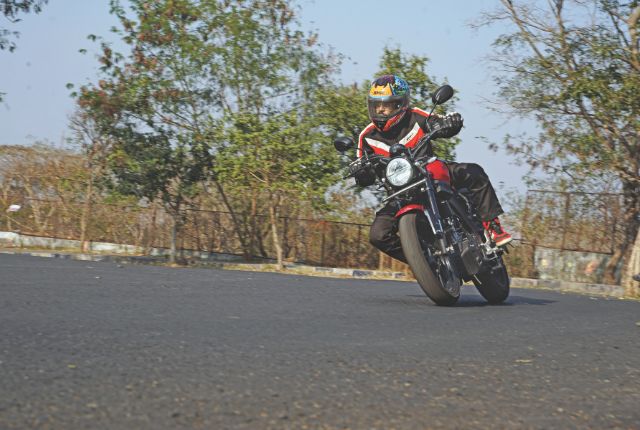
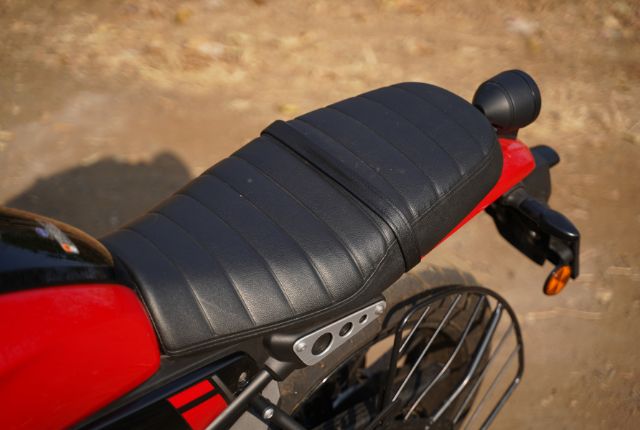
The upside-down (USD) fork at the front and the monoshock at the rear are set on the firmer side. The ride feels slightly harsh. But the bike feels really good when it is ridden on open roads. In corners, it feels composed and confidence-inspiring. And because it weighs just 137 kg and has a short wheelbase of just 1,325 millimetres, the bike is very nimble and easy to handle. The riding posture is slightly aggressive. Seat space, however, is limited. Taking a pillion can be difficult. Also there is no grab-handle for the pillion. Instead, Yamaha has provided a strap wrapped around the seat. The strap feels as if it will snap anytime. Taking a pillion rider might feel awkward as holding the rider is the best way to feel safe for the pillion.
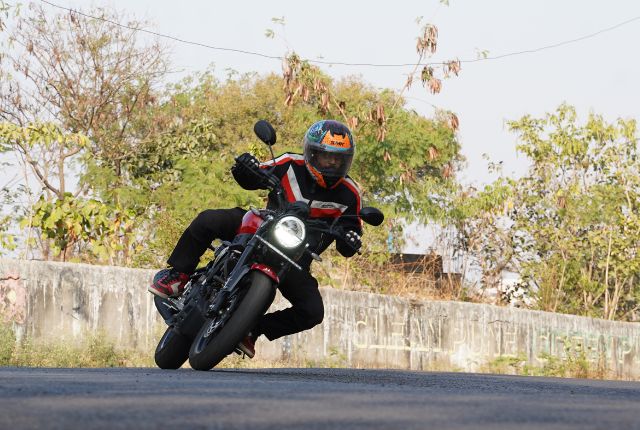
Braking duties are handled by disc brakes at both ends with a dual-channel anti-lock braking system (ABS), and they deliver strong, reassuring stopping power. Shoes tend to slip while using the metal rear brake foot-lever, though. Deeper knurling or a rubber surface would have improved grip. The XSR 155 has 17-inch alloy wheels shod with radial tyres from MRF. The grip levels are confidence-inspiring, allowing the rider to carry speed through corners with ease and reinforcing the bike’s agile, fun-to-ride character to provide a confidence-inspiring ride when riding in the twisties.
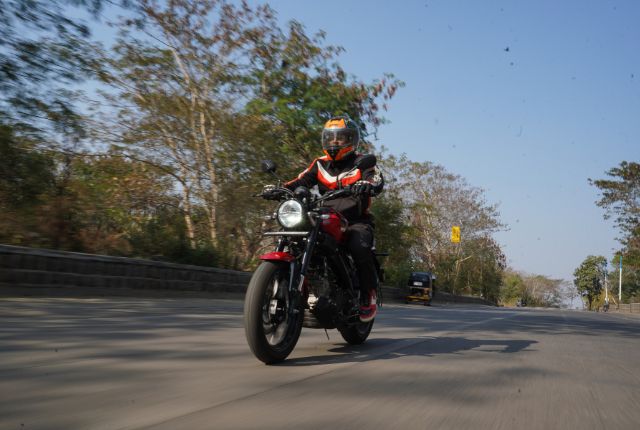
The Yamaha XSR 155 is priced from Rs 1.50 lakh (ex-showroom). Its closest rivals are the TVS Ronin and the Honda Hornet 2.0. Personally, I would prefer the Hornet 2.0 to the XSR 155 for its design, features, and engine refinement. Nevertheless, the XSR 155 is by no means a weak contender. It shines when it comes to the ride quality and ease of use. It’s just the design and build quality that put me in a dilemma. These factors make me think twice. Apart from that, I like the bike very much.

Leave a Reply