
The second iteration of Royal Enfield’s first liquid-cooled roadster, ridden long and hard in scenic locales
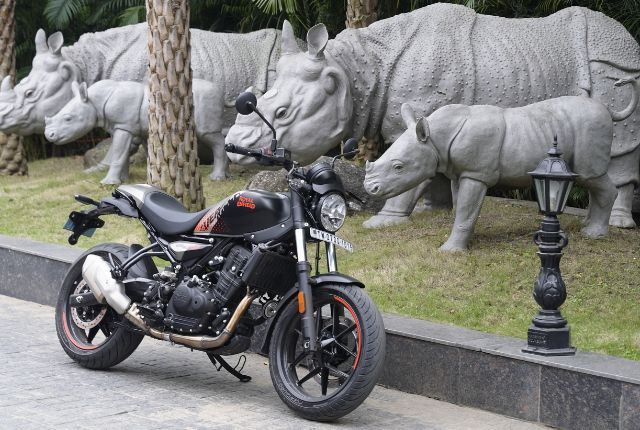
The first-gen Royal Enfield Guerilla 450 from two years ago was already a step in the right direction for the brand looking to stamp its name in the street-naked space. However, being that it was a brand new offering, it had quite a few rough edges which this 2026 update is meant to address. How well they had gone about it was precisely what we were out to ascertain in Guwahati, Assam. And yet, it wasn’t all cut-and-dry, as the unit we rode was that of the new bike’s range-topping Apex variant.
But, hold that thought, let’s get the changes on the entry and mid-level–Dash and Flash–variants out of the way first. Both now get a headlight grille and handle guards, with the Dash variant getting a new Twilight Blue colourway. Next, the Ceat Gripp XL tyres get a revised compound, which RE says allows for eight per cent and 17 per cent better grip in dry and wet conditions, respectively. And, the overhauled Royal Enfield app means the rider’s mobile screen no longer needs to be kept on for the map to be displayed on the console, does not disconnect when the rider’s mobile network falters, and can seamlessly run both Google Maps and GPX files.
Well, then, on to the main feature.
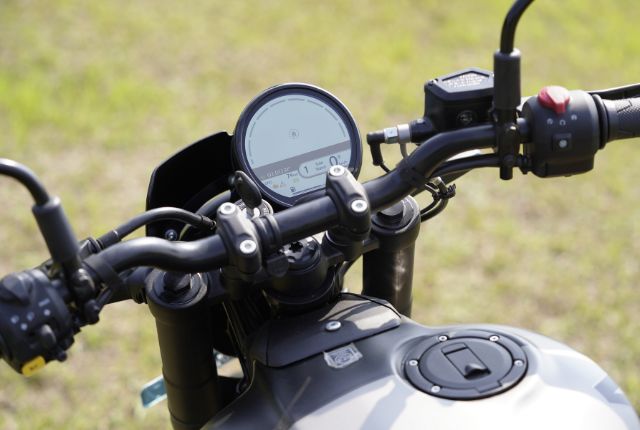
The cosmetic bits on the Guerilla 450 Apex include a sporty headlight cowl and removable pillion seat cowl, as well as three colourways, named matter-of-factly as Apex Black, Apex Green, and Apex Red. Moving to the functional changes, its handlebar is 56 mm lower and 57 mm farther from the rider, for a more engaged riding stance. And finally, it gets road-biased Vredestein Centauro ST tyres, in the same 120-section front and 160-section rear sizes as the 17-inch Ceats on the lower variants.
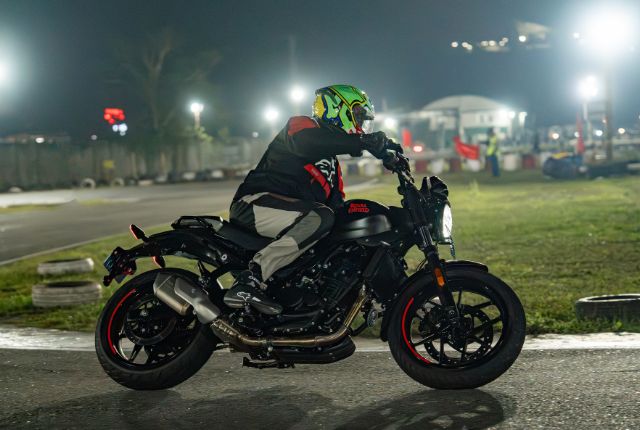
Now, such sweeping changes need the right platform for a thorough evaluation. So, Royal Enfield first let us loose on a go-kart track where, over ten-minute sessions, we were able to glean the improvements. The lower handlebar, which meant negligible shoulder engagement, allowed for easier inputs on the tight track, while the tyres held their ground well during the aforementioned quick transitions. That’s quite a feat, considering the Guerrilla’s long, 1,440-mm wheelbase, and 185-kg kerb weight; so we were suitably impressed.
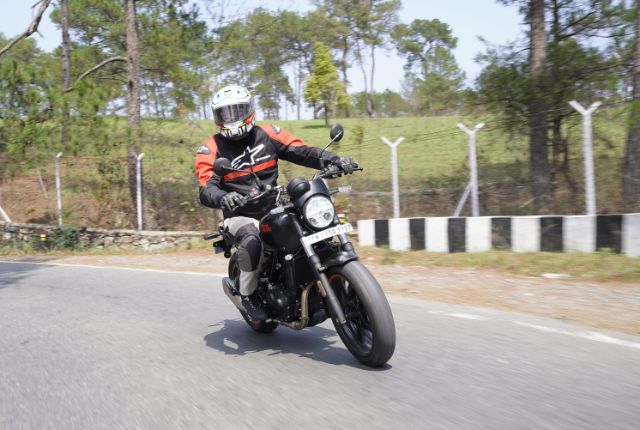
Breakfast the next day was at Umiam Lake, Meghalaya, roughly 75 km away from the hotel, for which we were let loose on the Guwahati-Shillong highway (NH6/NH40). The four-lane highway was replete with twists and turns, sudden elevations and declines, and all manner of vehicles from multi-axle trucks causing bottlenecks from hogging the fast lane, to locals on two-wheelers zipping across and even against traffic. Despite this, the Guerrilla didn’t put a step…er… tread wrong, with the suspension filtering out road imperfections well and the brakes usually needing just two fingers on the lever, even when coming to a halt from serious speeds.
Post breakfast, we were to return to the hotel, but this time using the map displayed on the console. Unfortunately for this correspondent, the spotty network coverage meant the console display was constantly flickering from full map mode to only turn-by-turn display. But credit where it’s due: despite the network bars dropping to none, the turn-by-turn prompts continued working without a hitch, right up to the hotel’s lobby!
As it appears, Royal Enfield has paid heed to the words of both reviewers and owners when updating the Guerrilla, and it shows. However, there are still multiple niggles to be pointed out. First, and you are free to disagree on this one, but the vintage-looking rotary-type ignition and headlight beam switches are better suited to a retro, air-cooled thumper, rather than a sporty, liquid-cooled roadster. Next, though the seat is firm enough for most riders to spend hours in the saddle free from back or hip pain, it’s scooped deeply enough to lock the rider in place, so taller riders like yours truly will need to get the optional flat seat so they can scoot back for a good enough grip on the tank’s knee recesses.
Speaking of which, a larger fuel tank would have been better, as the 11-litre unit not only seems under-equipped–the 150-km or so round trip had already exhausted almost two-thirds of its capacity–but also leads to the eyesore that is the empty spot between the tank and the headstock, filled in with the plastic element.
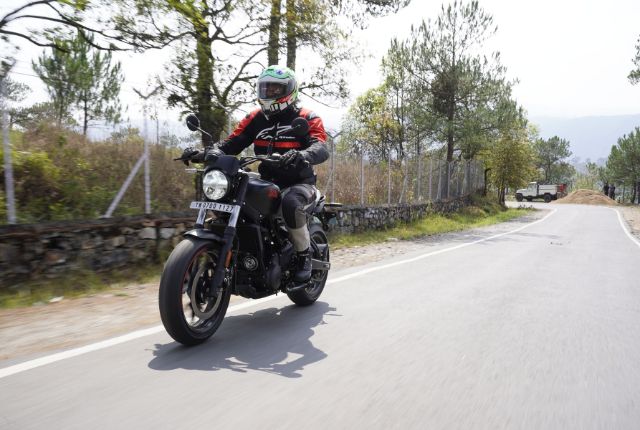
Even so, Royal Enfield’s comprehensive update to the Guerrilla has all the ingredients to impress even detractors. But its pricing is the real cherry on top. While the entry-level Dash variant retails at an ex-showroom Rs 2.67 lakh, and the mid-level Flash goes for Rs 2.72 lakh, RE has priced the top Apex variant at just Rs 2.49 lakh. This price tag, though introductory, undercuts its various Indo-British and Indo-Austrian rivals by a handsome margin, and may even cut into the sales of RE’s own 650 line-up. All said and done, though, the 2026 Guerrilla 450 Apex packs exactly what’s needed to fly off the showroom floors.
Leave a Reply