Smart Engineering
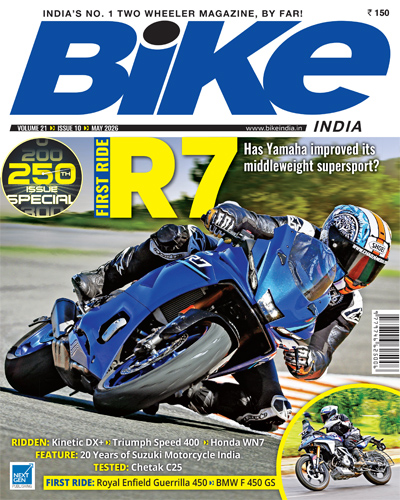
This month we celebrate the 250th issue of Bike India magazine. The BMW F 450 GS was launched last month at a starting price of Rs 4,70,000 for the entry level and Rs 5,30,000 for the top-of-the-line variant. These are introductory prices. The motorcycle has a parallel 450-cc twin-cylinder engine developing 48 hp at 8,750 rpm and a max torque of 43 Nm at 6,750 rpm, with a six-speed gearbox.
Incidentally, the GS 450 attracts the same amount of the Goods and Services Tax (GST) as the top-of-the-line BMW 7 Series, a luxury yacht, or a helicopter. This makes the GS 450 buyer feel as if they are in the same league, wealth-wise, as the owner of a ’copter or a luxury yacht.
To beat the exorbitant GST on motorcycles above 350-cc engine capacity, the engineers at Bajaj, Triumph, and KTM have done something very smart: they have reduced the engine capacity without incurring any extra cost, shortened the stroke, and increased the length of the connecting rod, and by doing this, everything remains the same so far as the hardware such as the height of the engine and rest of the engine internals are concerned. The only changes required are those in valve timing and ignition timing. The downside of making these changes is that the engine becomes more oversquare than before and this can cause loss of bottom-end and mid-range power and torque. It will be quite easy to convert your 350-cc KTM, Triumph or Bajaj bikes back into 400-cc machines by just changing the crankshaft and connecting rod and no one will be able to find out if you are running a 350-cc bike or a 400-cc one because they will look identical externally. Neither the RTO nor the GST official will be able to tell the difference.