
An afternoon with Ducati’s race-bred motocrosser at the Big Rock Dirt Park, Bengaluru, proved how true power doesn’t need to be menacing
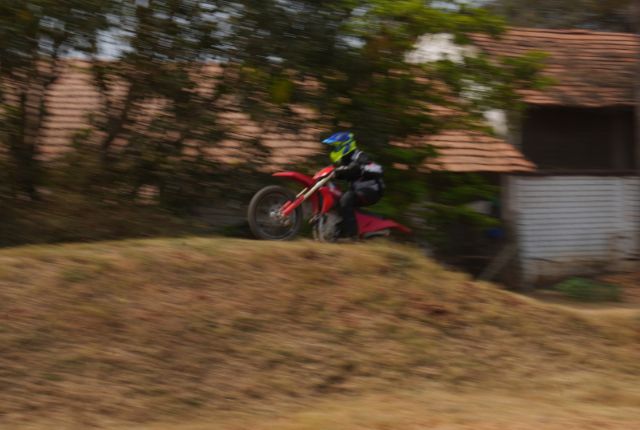
Ducati is well known from the plethora of delectable fully faired machines, and the myriad racetrack titles to their name. So, diversifying into—and nearly conquering, within just two years—the off-road arena isn’t at all far from character. The race-winner in question, the Desmo450 MX, is the brand’s first all-new launch of the promised 10 this year. And it comes with a trump card, hinted at in its name: the desmodromic valve actuation tech, that positively opens and closes the valves, allowing for more precise valve control and higher performance, perfected on the aforementioned World Superbike and MotoGP machines.
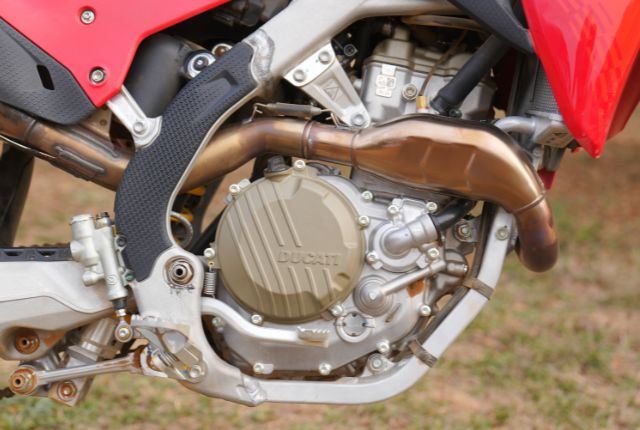
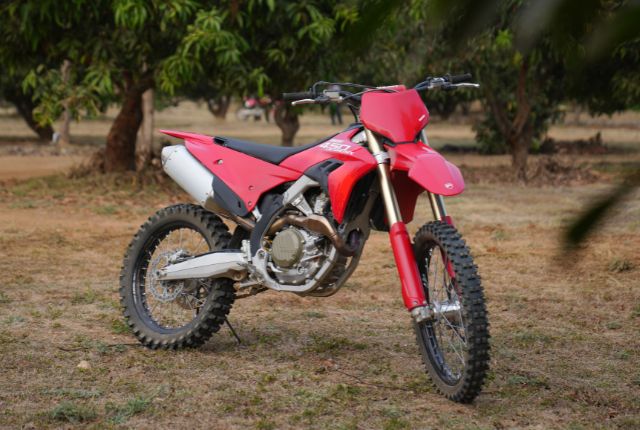
In the flesh, the Desmo450 MX’s minimal silhouette resembles other stereotypical motocross offerings. However, the tasteful, angular form, in trademark fiery red, imparts an unmistakable Ducati flair. Next, the all-aluminium perimeter frame is not only a featherweight 8.96 kg, but also features just 11 elements; the minimal welds enhance strength, while giving an impeccable look. Ditto for the aluminium swingarm, coming in under 3.5 kg. The race-bred engine, too, boasting a magnesium cylinder head, alternator and clutch cover, and titanium valves with a hollow stem, weighs a fighting-fit 26.8 kg. And all this, in conjunction with the Showa suspension, Excel wheels, and specially made Galfer rotors (260-mm front, 240-mm rear), keeps the Desmo450 MX’s overall weight, albeit without fuel, at a svelte 104.8 kg. This already formidable number, combined with the performance figures, 63.5 hp and 53.5 Nm from the 449.6-cc liquid-cooled single-cylinder engine, puts it in rarefied air. Speaking of which, the stratospheric 970-mm seat height was substantial even for this correspondent’s six-foot-two-inch frame. The slim body, then, was a saving grace, sparing the uncoordinated waddle when setting off from standstill.
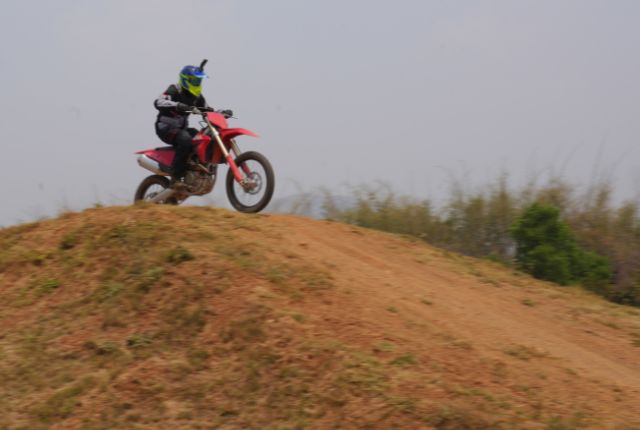
On track, even with Engine Map 1 (softer throttle action, more intrusive traction control, maximum engine braking) selected from the left switchgear, the response, with the accompanying exhaust growl, jolts you awake. Nonetheless, the sense of urgency (read: power delivery) does not feel overwhelming, allowing lesser-experienced off-road riders–like yours truly–to periodically twist the throttle liberally. Moreover, Ducati claims two-thirds of the total torque is available from about 4,500 rpm, offering the confidence needed to attack the massive, 10-foot-tall bumps in second or even third gear without the fear of stalling.
That said, the Desmo450 MX needs a deft hand. Despite the high centre of balance, you’ll still need to maintain leverage on the wide bars, hold the throttle steady, and keep the bike tipped in till it’s pointed in the right direction, lest the knobby tyres dig in and catapult you forward. However, the deck is hardly stacked against you: the traction control system, with integrated sensors on the camshaft and output shaft rather than on the wheel, is intuitive enough to manage activation as and when the wheels are airborne, even over multiple bumps.
Which brings us to another factor: the Desmo450 MX’s Showa 49-mm fork and rear shock feature a travel of 310 mm and 301 mm, respectively, but the spring rate differs drastically, at 46 N/mm at the rear, and just five N/mm at the front. This is done to reduce rear squat under hard acceleration, with the softer front theoretically maintaining better contact with the terrain. But considering the relatively slower pace, it translated to a front-biased feel, ideal when scaling larger bumps, but not so much when descending/landing from them. Another bit that stood out was the relatively limited engine braking, despite being in the highest setting. But credit where it’s due, the Brembo braking setup (dual-piston calliper front, single-piston rear) is not just effective, but also functions in a subtle, progressive, almost helpful way.
So, emboldened by the multiple incident-free laps around the Big Rock arena, I selected Engine Map 2, effectively pulling out all the stops. The result could be likened to the difference between sparring with a contender, and actually entering into the ring against one. The throttle demanded a lot more restraint, with the rear now braking traction even during shallower turns. And yet, the Ducati never felt unwieldy. Yes, it laid bare the difference between ambition and ability. But that only made the minor glimmers of brilliance–some airtime over a bump here, a minor powerslide there–seem all the more rewarding, as if it were whispering an encouraging “Maybe next time” rather than shouting “Send it” with a smirk.
Nevertheless, for those who can go toe-to-toe with this beast, the Ducati X Link app, available alongside the optional WiFi module, helps modify existing riding maps, with custom throttle response, engine braking, launch control, and quick shifter settings. It can even help create all new maps, as well as offer suggestions on suspension setup as per real-time riding data. And all this is on top of the usual information, like post ride stats and maintenance status. That last part, though, is of extreme importance, as the maintenance schedule of the Desmo450 MX, like every other serious motocross machine, depends on the hours the engine has run, rather than kilometres the bike has covered, with the 90-hour mark being the limit for an overhaul.
Summing up, despite being a serious motocross machine, the Desmo450 MX doesn’t feel hard-edged. Its Rs-17.23-lakh (ex-showroom) price-tag undoubtedly plays spoilsport, as its Japanese and Austrian rivals can be had for significantly less. But its encouraging power delivery, forgiving the minor follies of intermediate riders looking to upskill themselves, makes it a “heart rather than head” choice. And that, with the Ducati badge front and centre, makes the Desmo450 MX perhaps the most desirable motocross offering out there.

Leave a Reply